Forum Quantum Science and Technology 2025

FORUM 2025
Quantum Science and Technology
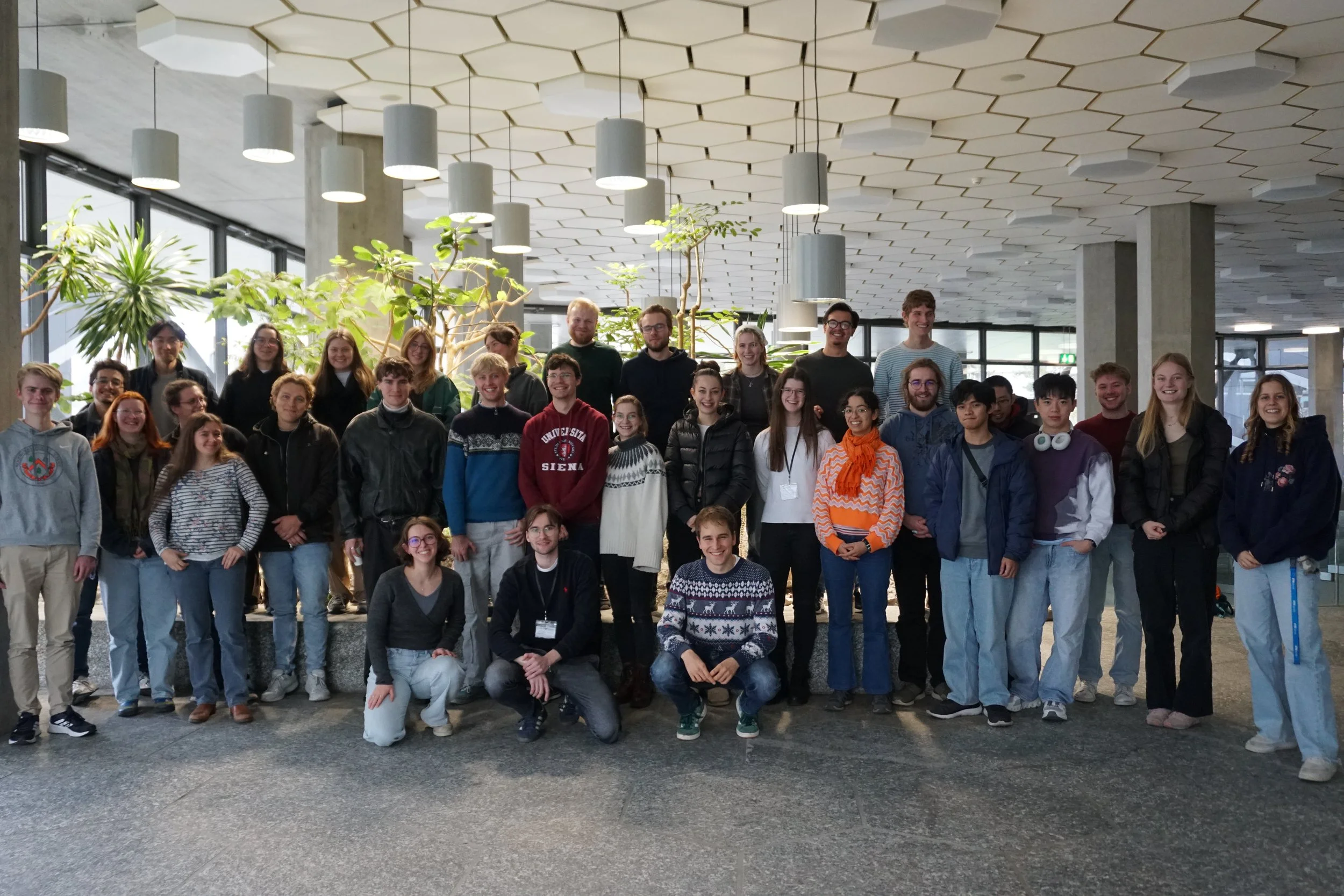
100 years of quantum mechanics. Over three days, we celebrated quantum science at our student forum, hearing lectures from leading experts and industry representatives, while also enjoying the opportunity to exchange ideas with the other participants.
We kicked things off on Friday at noon, the super motivated students even managed to catch their morning lectures. We dove straight into quantum science with Professor Yiwen Chu, who explored the time evolution of "cat states" prepared by coupling superconducting qubits to an acoustic resonator. Next, Professor Diana Craik demonstrated how trapped ions are useful not only for quantum computing but also for probing the precision frontier of the Standard Model. In a clever trapping scheme, the parity violating transition of a state in Ba+ is measured as a relative phase between two ions, while typical precision limiting effects for low-energy regimes appear only as a global phase.
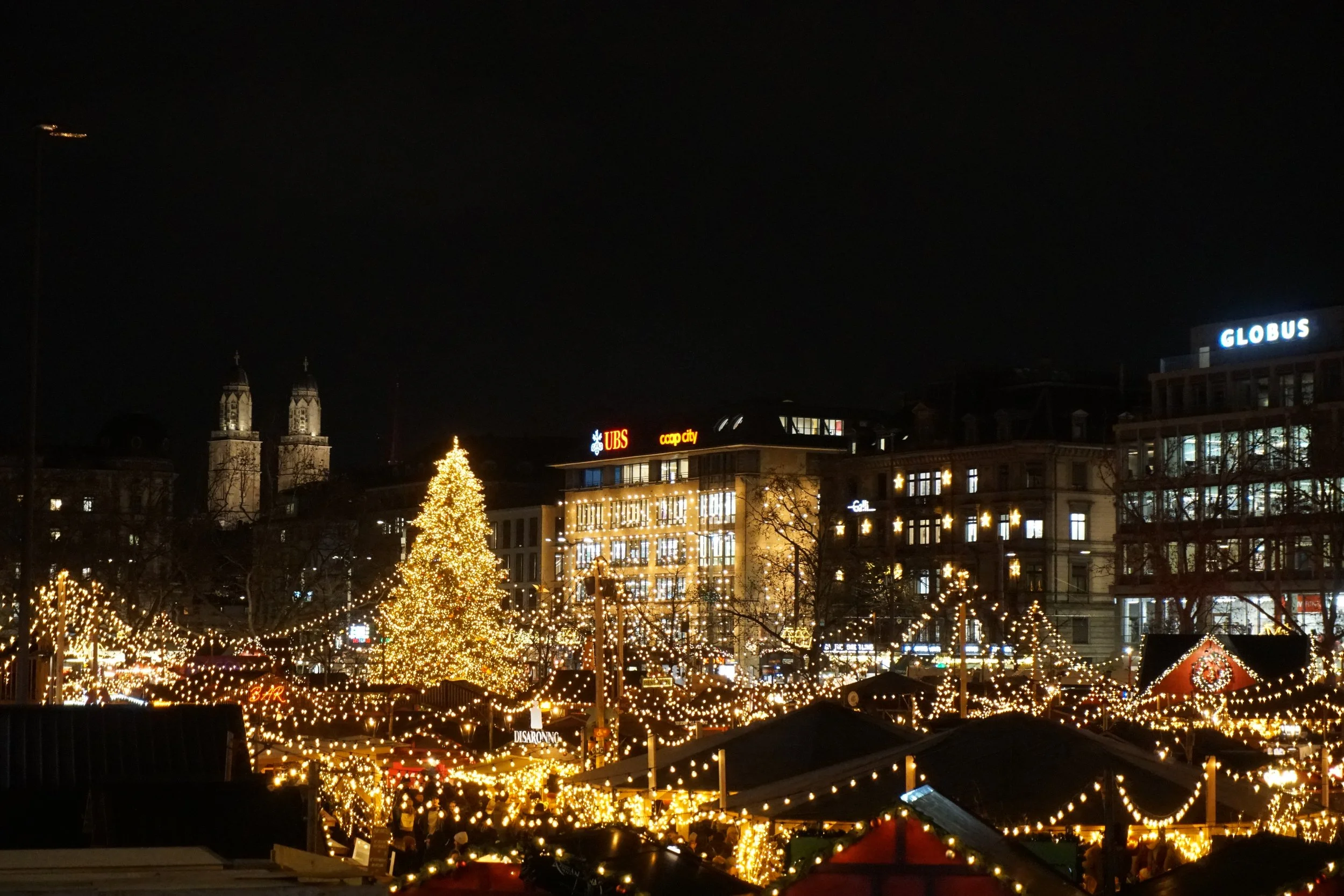
As our heads began to spin, it was time to head into the city, where we visited the beautiful Christmas market in front of the opera house and snacked on some fresh pastries. The day concluded with a group dinner before out-of-town students headed to their hostel and locals returned home.
We returned with new vigour the next morning to hear from Dr. Gabriel Hellmann, the CEO of QZabre. He spoke about magnetic field sensing with NV centres, and his career path was just as insightful and inspiring as his company’s work, showing us an alternative to a purely academic track.
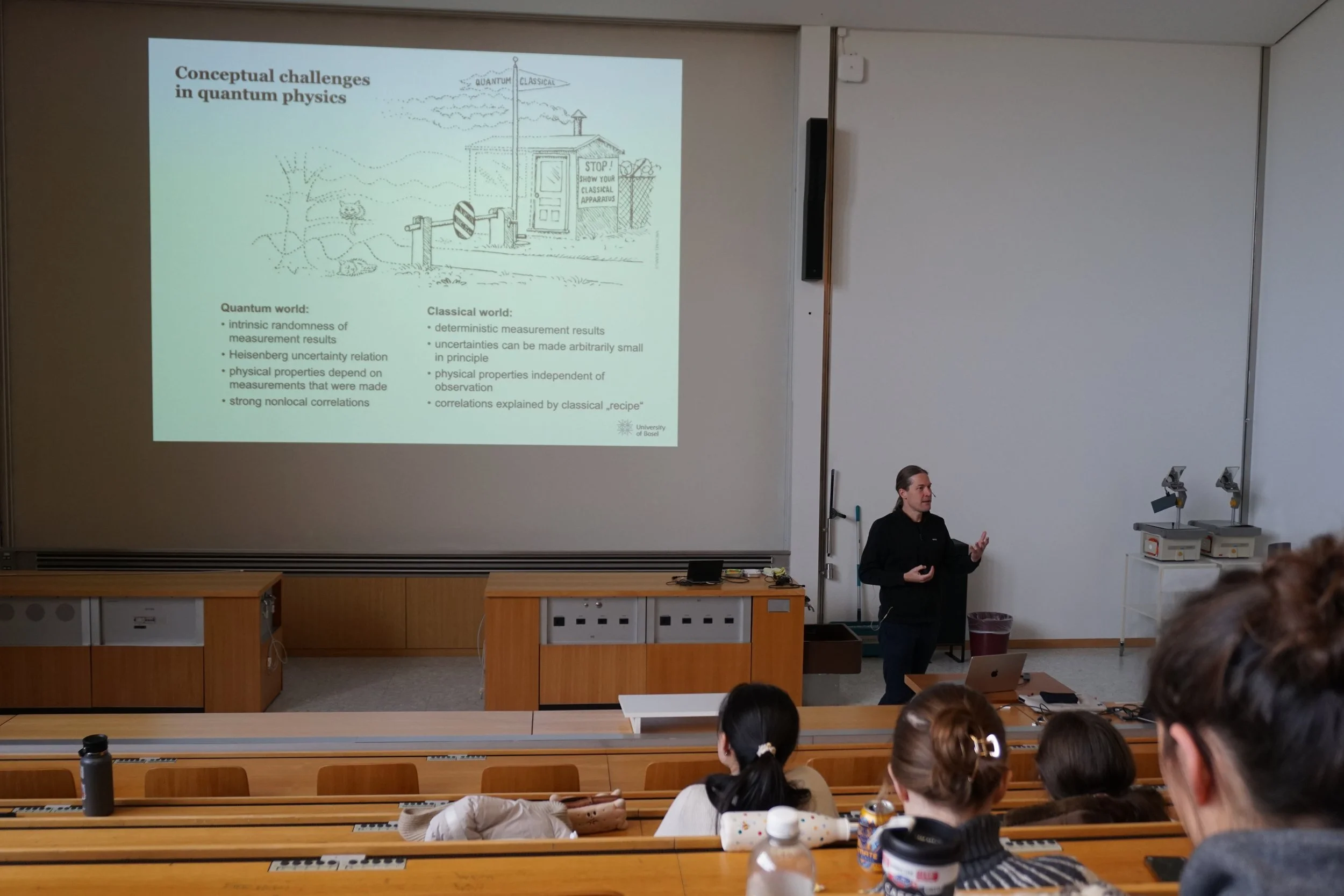
The metrology theme continued later that morning with Professor Philipp Treutlein, who broadened our understanding of the Heisenberg uncertainty bound. He highlighted the critical importance of locality and detailed his group’s efforts to test these principles with increasingly macroscopic ensembles of neutral atoms.
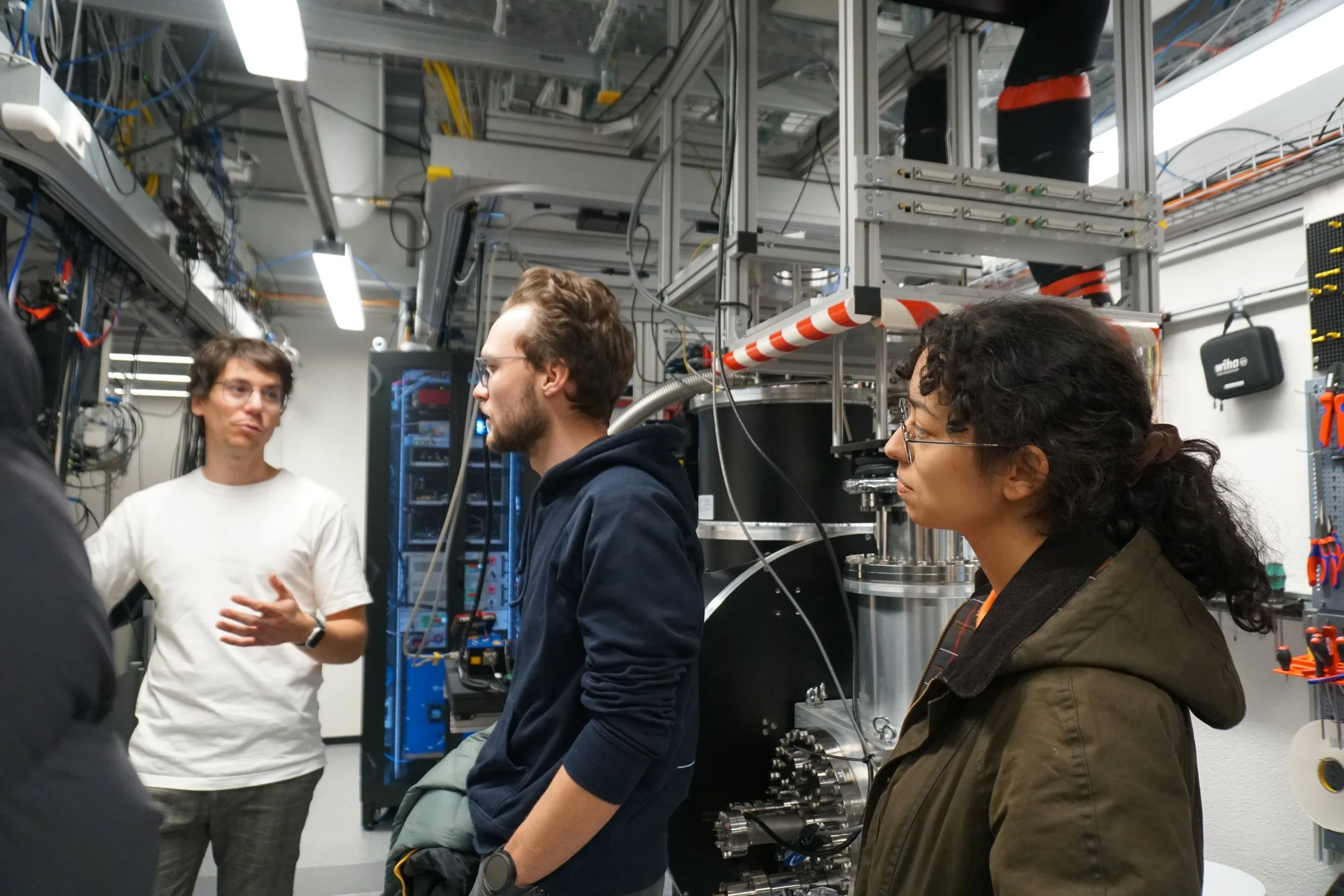
Shifting back to atomic chips, Dr. Matteo Mazzanti, a postdoc from the TIQI lab at ETH, explained the concepts behind trapped ion quantum computing. He described how the group maintains control over individual operations while scaling to larger ion numbers, using integrated photonic chips and individual Penning traps for each ion. He then gave us a fantastic tour of his lab, where we had the chance to ask technical questions and see firsthand the difficulties of implementing these minuscule systems in a sufficiently shielded environment with a uniform magnetic field.
Just like that it was already the final day of the forum. We gathered for a brunch before the closing talk by Professor Johan Chang. He discussed the development and use cases of high temperature superconductors, tracing the journey from historical approaches to contemporary strategies in the ongoing quest for higher operating temperatures without resorting to high pressure.
Now, a day after the forum, we look back on a great forum with a plethora of scientific talks and countless conversations with like-minded peers. We are very grateful for the contributions of all the speakers, and of course we thank all the participants for attending and sharing these exciting few days with us. We cannot wait for next year’s forum in the spring!
Your YPF team